
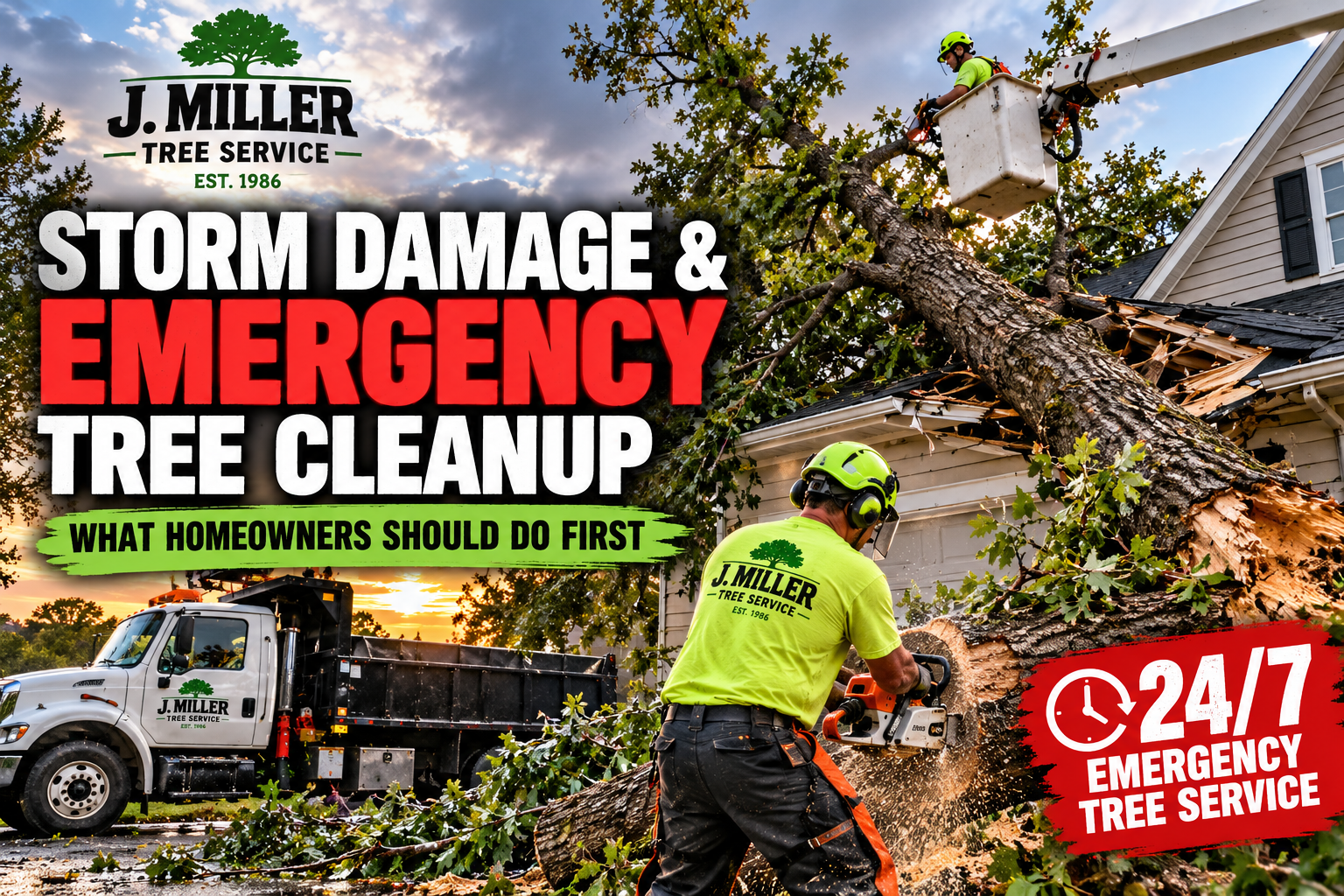
Storm Damage & Emergency Tree Cleanup: What Homeowners Should Do First
Severe weather can turn a healthy-looking tree into a serious hazard in a matter of minutes.
High winds, thunderstorms, heavy snow, and ice can snap large branches, split trunks, uproot trees, and send trees crashing onto homes, garages, vehicles, fences, and power lines.
When that happens, your first instinct may be to start cleaning up immediately.
Don’t.
Storm-damaged trees can be extremely unpredictable. Before reaching for a chainsaw or trying to move a fallen limb, make sure you understand the risks and know when it’s time to call a professional.
Here’s what homeowners should do first after discovering storm damage on their property.
1. Make Sure Everyone Is Safe
Before worrying about cleanup, check for immediate hazards.
Keep family members, neighbors, children, and pets away from damaged trees and fallen branches.
A branch that appears stable may still be partially attached to the tree. Split trunks and uprooted trees can also shift without warning.
If a tree or large limb has fallen onto your home, garage, or another structure, stay away from the damaged area until you know it’s safe.
Property can be repaired. Your first priority should always be keeping people out of danger.
2. Stay Away From Downed Power Lines
If a tree or branch has fallen onto or near electrical lines, do not approach it.
Never assume a downed line is inactive.
Electricity can travel through tree limbs, wet ground, fences, vehicles, and other nearby objects.
Keep everyone away from the area and contact the appropriate utility or emergency service.
Tree removal around active power lines requires special precautions and should never be treated as a DIY cleanup project.
3. Look for Hanging and Broken Limbs
Some of the most dangerous storm damage isn’t lying on the ground.
Look upward.
Broken branches can remain suspended high in a tree after a storm. Sometimes called “hangers,” these limbs may fall later with little or no warning.
Also watch for:
- Split or cracked branches
- Broken tree tops
- Partially detached limbs
- Large branches resting on other branches
- Limbs hanging over roofs or driveways
- Newly exposed or damaged sections of the trunk
If you see overhead damage, avoid walking or parking underneath the tree.
4. Check for Leaning or Uprooted Trees
Strong winds and saturated soil can weaken a tree’s root system.
After a severe storm, look for trees that are leaning differently than they were before.
Warning signs can include:
- Exposed roots
- Lifted soil around the base
- Cracks in the ground
- A newly leaning trunk
- Broken or disturbed roots
- Movement around the root ball
A partially uprooted tree can be especially dangerous because its remaining roots may be supporting thousands of pounds of weight.
Don’t attempt to push, pull, cut, or straighten an unstable tree yourself.
5. Don’t Assume a Chainsaw Makes the Job Safe
A chainsaw is a powerful tool, but it doesn’t make storm-damaged trees predictable.
Broken trees and limbs can contain tremendous stored pressure.
Cutting the wrong section can cause a branch to spring, roll, split, swing, or fall in an unexpected direction.
This becomes even more dangerous when you’re dealing with large trees, elevated branches, damaged trunks, or trees resting against buildings.
Professional storm damage tree cleanup involves more than cutting wood. It requires understanding how the tree’s weight and tension will change as individual sections are removed.
6. Document Property Damage Before Cleanup
If a tree has damaged your home, garage, vehicle, fence, or other property, take photographs and video before major cleanup begins, provided you can do so safely.
Document:
- The fallen tree or branches
- Damage to structures
- Damage to vehicles
- The surrounding property
- The tree’s original location
- Any visible storm damage
Your insurance company may request documentation when reviewing a claim.
If there is significant structural damage, contact your insurance provider and follow their instructions.
7. Know When You Need Emergency Tree Service
Not every broken branch requires an emergency response.
Some situations shouldn’t wait.
Consider calling for emergency tree service when:
- A tree has fallen on a home or building
- A tree is blocking a driveway or access point
- Large branches are hanging dangerously overhead
- A tree has suddenly begun leaning
- A tree has partially uprooted
- The trunk has split
- Storm damage threatens nearby structures
- A damaged tree creates an immediate safety hazard
These situations can become worse if additional wind, rain, snow, or ice arrives.
8. Professional Equipment Matters After a Storm
Storm cleanup can involve extremely large and heavy sections of trees in difficult locations.
That’s where specialized equipment becomes important.
J. Miller Tree Service has equipment for challenging tree removal and storm cleanup projects, including a 65-foot bucket truck, 85-foot spider lift, 28-ton crane with up to 145 feet of reach, wood chippers, and stump grinders.
Cranes, lifts, rigging equipment, and experienced crews allow damaged trees to be dismantled in controlled sections rather than simply cutting them and hoping gravity cooperates.
When a tree is hanging over a house, wedged between other trees, or located in a difficult-to-access area, that control matters.
Can a Storm-Damaged Tree Be Saved?
Storm damage doesn’t automatically mean a tree needs to be removed.
Some trees can be preserved through professional trimming and removal of damaged limbs.
The answer depends on factors such as the extent of the damage, the condition of the trunk, the root system, the tree’s overall health, and whether enough healthy structure remains.
An experienced tree professional can evaluate the damage and determine whether trimming, preservation, or complete removal is the safest option.
Don’t Wait Until the Next Storm
A damaged tree that survives one storm may not survive the next one.
Branches weakened by wind or ice can remain attached temporarily, while cracked trunks and damaged root systems may continue deteriorating.
Taking care of storm damage early can help prevent a dangerous tree from becoming an even bigger problem later.
24/7 Emergency Tree Service in the Erie Area
J. Miller Tree Service has served the region since 1986, helping homeowners, businesses, and property owners handle difficult and hazardous tree situations.
We provide:
- 24/7 emergency tree service
- Storm damage cleanup
- Fallen tree removal
- Hazardous tree removal
- Tree trimming
- Crane and bucket truck services
- Stump removal and grinding
- Land clearing
- Tree preservation
We serve Erie County, Northwestern Pennsylvania, and surrounding areas.
Need Emergency Tree Cleanup?
If a storm has left you with a fallen tree, dangerous branches, or a damaged tree threatening your property, don’t put yourself at risk trying to handle it alone. Contact J. Miller Tree Service for professional storm damage tree cleanup and emergency tree service.
📞 Call 814-881-7221
🌳 J. Miller Tree Service
Serving the Erie area since 1986.
24/7 Emergency Tree Service